
It was the end of 2019, a time before our generation knew what a global disaster was, when video conferencing was reserved for teams spread across country borders, and TikTok had not yet transformed marketing and entertainment. I was a second-year student in the field of agriculture. Living in Johannesburg, the capital city of South Africa, I did not grow up with much experience in farm life or agricultural production. In my endeavours to find any form of agricultural experience in the most urban area within the country, I stumbled upon Urban Farmer. I fell in love with the company and their mission to make positive contributions to African animal protein production. Before I knew it, I boarded a plane to Zambia, where I monitored some feed trials as a student learner. At the time, I knew in my heart that someday, I would like to return to Urban Farmer. Little did I know it would be so soon, and it was beyond my wildest dreams to be in my dream position - training smallholder farmers all across Africa.
In April 2023, I received the phone call that would make one of my biggest dreams come true. I was finally offered a position at Urban Farmer. But my dream position - to train and work with smallholder farmers across several African countries. I knew that the job at hand was going to be challenging, but I had no idea how much I would learn. Armed with my university degrees and a passion, I had a lot of background knowledge, but the industry has taught me things I would have had a hard time learning from a formal classroom.
There are many lessons I have learned in training smallholder farmers, which I will write about extensively in future articles. But here are three main things I have learned as an early career professional in agriculture.
I attended the Global Leadership Summit in 2019. There was a speaker named Carla Harris. What an inspiring lady. You should go read about her. Anyway, she spoke words that altered the way I approached my career forever:
“Your authenticity is your own unique competitive advantage.”
She spoke about how being a gospel singer, a mother, an artist, and a banker made her uniquely able to relate to her customers. She realised that she did not have to pose in the “investment banker” mould and that bringing every part of her into the room put her ahead.
In agriculture, we need it all. We need photographers, teachers, speakers, readers, mathematicians, tech enthusiasts, accountants, supply chain specialists, laboratory experts, field technicians, people who like dirty boots, mechanics, data analysts, policymakers, marketing experts, product designers, and thousands more.
I trained to be an agricultural economist. Some days, I am knee-deep in gumboots mixing feed on a farm. Other days I am a teacher with a class of diverse students. On other occasions, I work in marketing, sales, or finance.
When I walked into agriculture, I was worried that I would be restricted. The longer I stay in agriculture, the more I find that it is the most freeing and diverse field you could ever enter. All your skills are welcome in this sector. Agriculture employs the most people globally, so there will always be room for people who bring an array of interesting skills, talents, and interests to the table.
John Rohn once said, “You are the average of the five people you spend the most time with.” I have tried and tested this in my life over and over again, and it proves true every time. Never underestimate the power of your colleagues on your growth, well-being, and personal development.
In one of my first interviews, I asked my would-be boss this question. I asked, “If I were to walk down this hall and pick five random people, would I be proud if I were the average between them in character?” He looked a little surprised by the question. I stand by my opinion that this is an important question you need to ask yourself frequently about the organisation you find yourself in.
I cannot overstate the importance of culture in the organisations you work for. The relationships you forge with your superiors and peers will play a critical role in the momentum you are able to achieve not only at the start of your career, but all the way through to the end.
I have taken positions in the past that were not 100% aligned with my long-term career goals, within organisations that did not quite align with my personal values. I understand the realities of the job market. As beginners in the industry, we often don’t have as much freedom of choice in the desperation to get started, oftentimes to start tackling student debt. We all have to start somewhere.
Prioritise identifying people within your daily environment and within your industry who inspire you, challenge you to be better, and most importantly, whose values align with yours.
Our generation has been branded a generation with very little determination and perseverance. I don’t think it is always our fault; a lot of this behaviour has been shaped by the circumstances we grew up in. Parenting styles that changed, the rapid adoption of technology, the introduction of social media, and the rise of instant gratification culture.
While we don’t need to feel ashamed or burden ourselves with unnecessary blame, we do have the responsibility to understand our own weaknesses arising from our generational behaviours and to be aware when they influence our behaviour towards others and within our careers.
I won’t get into the psychology of all this here, but I highly recommend this interview with Simon Sinek on the topic.
I have applied the principle in my life that I am not allowed to quit until I have reaped a reward in whatever I started. Say you pick up running as a hobby, you should not give up until you finish your first 5k. If you decide to start learning to draw, you should not give up until you have produced something you feel proud to hang on a wall.
In your career - you cannot quit until you start seeing the rewards of whatever career path you are on. You will quickly discover that changing jobs every six months does not reap rewards. Why? Meaningful rewards take time.
If you remain with something long enough to reap its rewards, then you have a better understanding of what you are giving up on. By all means, make a change. But before you have not reaped the rewards, and you quit, you can easily find yourself in a trap of believing you don’t fit in anywhere, nothing makes you happy, and like you don’t make a difference.
Our entire generation feels this way. Be aware of it. Impact takes time. Meaningful growth takes patience. Practise the principles of reward before quitting. Your decisions are much more informed this way, and I can promise you, you’ll move further and faster than peers who move often, but sporadically.
These career lessons are applicable in any industry. I have just happened to learn them from shovelling manure on pig farms, feeding day-old chicks on chicken farms in remote places, and more recently in leading a team through the discovery process of a new business model and learning how to manage impact investment projects in Africa. Whether you are working in a lab or on a farm, from a hotel room or from an office - the agricultural industry has lots to teach you. You just have to volunteer yourself into opportunities - particularly the ones that scare you and that you know nothing about. If you are aspiring to work in a finance, marketing, operations, or sales department - you can do that within agriculture too.
Agriculture has opened the world for me. Agriculture is everywhere. Agriculture needs everyone on board.
These might only be three lessons I have learned summed up in an article. But Agriculture is unique in its ability to take you places, teach you about life, people, and the environment.
Michelle Marais

Anyone who has been in school or university is still part of the generation who could not rely on ChatGPT to write their essays and articles for them. Some of us love writing, some of us hate it, but all of us learn from it.
In my experience, most of us in the agricultural sector did not end up here to pursue a love for writing. We generally end up in this sector due to a love and passion for farming or a love and passion for studying and developing the farming industry. We have the doers – those who are feet-in-the-mud and loving it – and the thinkers – those who are working tirelessly in laboratories or conducting various studies to better the agricultural sector through research, development, and innovation. In this article, I want to inspire you, as an agricultural enthusiast or professional, to write more, and I am going to tell you why.
When I was in university, I had a brilliant professor who always used to say,
“When you don’t have time to write a short letter, you write a long one.”
This has rung true in my experience long after my master's thesis. Writing in a short, powerful, engaging, and comprehensive way is not an easy task. I find it easier to write a 10-page article than a well-rounded two-pager. Why is that?
Writing a short, impactful, comprehensive piece requires you, as the writer, to refine your thoughts, focus on articulation, and order them in such a way that your audience can follow along and walk away with a clear message.
Practicing writing will help you develop the skill to refine your thoughts and present them in short and effective ways.
Have you ever watched a TED-X talk or seen a speaker engage an audience on a stage where you find yourself captivated by that person’s ability to communicate so well? I know I have.
But Mark Twain once said,
“It usually takes more than three weeks to prepare a good impromptu speech.”
Have you ever noticed how some of the best speakers happen to be authors? Speakers like Simon Sinek or Brené Brown are perfect examples. Their TED talks went viral almost overnight as people became engulfed by their talks, which were informative, inspiring, and powerful. I believe the fact that they have spent years refining their thoughts around their particular subject matter is more than half the reason why they are such brilliant speakers. They wrote, then they spoke. They have repeatedly done this over a series of books and speaking events. I am sure you could put either one of them on a stage to speak on the fly today, and while they may be unprepared for that specific moment, their preparation and foundation for captivating and informative speaking are captured in the hundreds of notebooks in their studies while they were writing.
Practicing writing will, over time, make you a better speaker and empower you to communicate your ideas and opinions eloquently on multiple different platforms.
Think about an expert in the agricultural field who you aspire to be like. Can you think of any? What makes them an expert?
The dictionary defines expertise as “A high level of skill or knowledge in a particular area, often recognised by others within that field.”
Many of us aspire to become recognised in the industry as experts in the field we are passionate about. The wise Robert Greene once said,
“Experts are not born; they are made through relentless effort and dedication.”
And David Epstein, who happens to be a New York Best Selling Author, well-known journalist, and popular TEDx speaker, says that expertise is not a static condition but a constant pursuit. There are many talented visionaries in the agricultural sector who are not recognised as broadly as they could be. There are ideas waiting to change the world that can be challenged and bettered only once they are shared and accessible to an audience who are passionate about the same cause.
Writing can help you build your credibility and visibility within the industry while aiding your network-building efforts in relevant fields.
We are living in the 21st century. Gone are the days when people raced to the music store to buy an album the week it was released. Gone are the days when you needed to sign a deal with a publicist to share your ideas and thoughts through the written word. With websites being accessible to all of us, and free platforms like LinkedIn and Facebook, you can start sharing your ideas and visions tomorrow.
Writing beyond what is required for your course material or job description is, in my opinion, one of the first things that can make you stand out in the industry.
Writing will help you navigate your own interests and future pursuits in the industry.
You will quickly discover what bores you and what interests you based on your willingness to write about it. Writing can be your compass in your career path because it keeps you so well in tune with your inner self, your true interests, your desired audience and networks, and your vision.
Writing can be challenging at first, but once you have found what you want to write about, and who you want to write to, you are on your way to building your expertise and meeting the right people to help you on your journey.
What are you afraid of? Every well recognised and respected expert was once a beginner.
Michelle Marais
An opportunity for junior agri-writers:
There is a great writing competition open until the end of August 2024 on Agri News Portal.
Check it out here
All international entries are welcome. You must be younger than 28 to enter. There is a technical and non-technical category. Whether you want to share your research or an inspiring agricultural story, this is your opportunity.
The day after a conference, a LinkedIn feed is filled with lots of posts sharing overviews of talks that took place, awards being celebrated, and new partnerships being announced. But seldom do people talk about the recovery day one needs after a week of networking, socialising, and engaging in conferences.
When I got on the bus to start my 48-hour journey home, I made my way down the aisle to seat 34. I was coincidentally placed next to students who had attended the congress, and one exclaimed, “Michelle, it’s like the universe wanted us to talk some more!” While I was deeply grateful for the engagement of the congress, I also felt my need for some rest and “introvert time” creep up on me. When the bus took off, it was not long before the students from the congress were all fast asleep, and I almost had a silent prayer of gratitude because, by this time, my voice was tired after many consecutive days and very late nights of intense connection and interaction. I was relieved to take a break from talking, and perhaps even from sharing enthusiasm with the young people in my mission to contribute to youth engagement in agriculture.
The passenger next to me asked (in Spanish) if he could turn the air conditioning off as he was getting cold. My Spanish is very limited, but after answering him that it was no problem, he assumed I could speak the language and tried to engage in conversation with me. He quickly learned that I had a little comprehension of what he was saying but had no idea how to respond. I quickly realised that his English was even more limited than my Spanish. Welcome to the world of international travel.
But this is where technology is changing the world. It was a matter of seconds, and we were both on our phones using translation tools. Suddenly, we were able to communicate. Somewhat slower than a normal conversation, but in a sense so much more intentional because it took an extended effort for both of us to engage.
For two and a half hours, we “spoke” about agriculture. He told me about his mechanical engineering studies and his love for biology and asked how he could marry those passions. He asked about my travel experience, and I was flipping between photos on my phone and the translate app, showing him pictures of some of our farmers and highlights from the 12 countries I have visited in an agricultural capacity.
We shared book recommendations, and he asked lots of advice about how to get involved in agriculture. We shared concerns about food security and the economic relevance of the food sector.
When I got off the bus, we took a picture together because I want to remember this day when we speak again in the future. Antonio has enrolled in English lessons recently, so maybe next time our communication might look a little different.
As a young and talented man born and raised in Almería, I am sure with the right guidance he will make significant contributions to this industry.
I got on that bus hoping to rest, not to be required to speak, and to recover from a wonderful and successful week at IFAMA.
I did not need my voice once.
“Become the person you needed” – a motto I try to live by. I was reminded that most of the time that call actually happens outside of the realms where we think it would - like on a bus between Almeria and Malaga.
Without the many people who have given me little pieces of advice and guidance along the way, I would not have been in a position to influence and grow the sector by passing it along. I now have a new appreciation that sometimes it might have been at inconvenient times when their priorities were different. Yet - they gave me their time.
Your impact will always be more than you can measure. It will always come from more than conference stages and awards ceremonies. We just have to be willing to open our eyes, and wholeheartedly engage.
Michelle Marais
When I first got invited to speak at the World Seed Congress, I could not help but wonder if I would not be a little misplaced at this conference as one of the only delegates from the livestock sector at such a momentous event for the seed industry. The 100th World Seed Congress hosted by the International Seed Federation took place from 27-29 May in Rotterdam. I learned a lot about the sector as an “outsider” and in this article, I will outline my key revelations and learnings throughout the event.
The Power of Seed
As an agricultural professional, I understood seed as being the starting point of all plant life and agricultural value chains, but the congress deepened my awareness of the power and influence of seed. Seeds are not merely biological entities. They wield significant power over food security, economic stability, environmental sustainability, and global trade. The World Bank estimates that approximately 26% of global employment is in the agricultural sector. Not only does the seed sector provide influential employment opportunities, but it also forms the foundation for millions of employees worldwide1 in an industry valued at approximately $69.3 billion.
Whilst I always understood the biological importance of seeds, their political and economic influence was highlighted throughout this congress. I learned about the importance and challenges of policy and regulation and witnessed the collaborative efforts from all seed sector stakeholders to address these challenges. There appeared to be abundant political interest and attendance of global political delegates at the conference to engage in these conversations.
The successful alignment of seed producers, farmers, processors, retailers, regulators, and all other stakeholders within the industry required representation from across the board at the congress - which made it an interesting and engaging congress to attend. Attendees included the King and the ex-Prime Minister of the Netherlands, the Deputy Director General of the FAO, leaders from the WTO, World Farmers Organisation, and international research, fertiliser, and retailer associations, to name a few. With almost 2000 attendees at this year’s congress, the influence of the seed sector cannot be understated. As someone new to the seed sector at a level as deep as the World Seed Congress, it was eye-opening to see not only the vast collaboration in the sector, but also the array of opportunities this sector holds in business, production, research, and development, education and training, technological innovation, regulatory control, logistics, plant breeding, and more.
Intellectual Property Rights in the Seed Sector
The congress had many exhibitors, many of whom were promoting advances in biotechnology. The uprising in biotechnology that the seed sector has experienced, launched it into the realm of intellectual property rights. The research and development which needs to be undertaken to produce new crop varieties is extensive, expensive, and time-consuming. Corporates are investing heavily into these developments and rely on intellectual property rights to obtain a return on investment. Patents protect their investments by enabling exclusivity to the production and sale of seeds. With the control of such a critical component of the food supply chain resting in the hands of private corporations, significant political implications arise. Monopolies or market domination limits farmer’s choices and increases seed cost. With the rising pressures of climate change and the global need to produce more food and fibre, the seed sector is required to innovate at a speed and efficiency like never before. The IP debate in the context of agricultural value chains is intricate and interesting, in the attempt to balance the urgent call for investment and innovation with the urgent need for improved and increased production.
The Seed Sector in 50 Years
With the 2024 World Seed Congress being the centennial event for the ISF, significant focus was placed on the future of the seed sector. An interactive “chaos” session saw 100 congress attendees from all generations and backgrounds work together in teams to envision the future of the industry.
Discussions about the influence of Blockchain technology on IP and information sharing, the potential of free trade in the seed sector in the future, the change in growing practices, and projected biotechnological advances, this session highlighted the aspirations of current generations for the future of the seed sector while highlighting that the future of the seed sector is uncertain as far as 50 years into the future.
Throughout this session, it was evident that the seed sector is constantly faced with the trade-off between the need for meeting sufficient, affordable, quality food production in the required geographies in an environmentally and socially responsible way – with the immense regulatory, investment, and R&D undertaking required to reach those goals.
Seeds as the Vessel to Growth and Life
Seeds are the beginning of all life. As Beck Bethdol of the FAO pointed out during the opening ceremony, “Seed security is food security.” The seed sector holds immense power, and with that great power comes great responsibility in the approach to the challenges this indispensable industry faces.
The International Seed Federation (ISF) facilitates the annual World Seed Congress to bring together all seed sector stakeholders and to drive the industry and the world forward.
If you would like to learn more about ISF and the World Seed Congress taking place next year in Istanbul, visit https://worldseed.org/.
Michelle Marais
References:
1: World Bank Open Data by the International Labour Organisation: ilostat.ilo.org/data.
Associated image Dall-E.
"At the very heart of agriculture is the drive to feed the world." - Ben Potter
I was having a cup of coffee and a muffin at OR Tambo International Airport recently whilst waiting for a flight. As the waitress placed my order on the table, I thought about the many agricultural processes that had to take place for me to indulge in a seemingly mundane meal in a bustling airport terminal where nobody else seemed to be thinking about agriculture. Somewhere, a farmer produced seed; another planted that seed to produce wheat, nourished it with fertiliser, protected it with herbicides and pesticides, harvested it, and passed it over to the dozens of players in the value chain to produce high-quality flour. Another farmer planted maize or soy to produce the feed for the hen that laid the eggs. Somewhere, another farmer had to cultivate lush pastures for a cow to graze to produce the cup of milk which, down the road, got mixed into my muffin batter and my coffee. Each ingredient was touched by a farmer. That is not yet mentioning the cocoa farmer in Ghana or the coffee farmer in Costa Rica who cultivated products for people in countries they would most likely never see. I have always been amazed by the intricacy of agricultural value chains and the immense impact they have on economic factors like employment. I am convinced that if our society better understood the role of agricultural value chains in their personal livelihoods, we would have a greater respect for food.
Whilst my family finished their meal, tears welled up in their eyes. A year ago, they left me at the airport as I departed for Spain to pursue an opportunity in agriculture, thinking they would be like so many other South African parents – with children scattered across the globe. But this time, it was my younger brother, a young engineer and bubbling pot of potential, who was departing to the Netherlands, where he has now started the rest of his life alongside thousands of other South Africans who are also celebrating the hard work and dedication it takes to be able to leave the country. I thought about my muffin and every person and life that was touched simply by the demand for a lemon-poppy snack – and the sheer demand for food. Regardless of whether the consumer is in the Netherlands or in Gauteng, food will always be their top demand, and farmers will have a purpose. South Africa has abundant natural resources and an agricultural history worth being proud of. Whether our fruit is enjoyed in Paris or Parys, our agricultural mission is noble.
We form part of a generation where one of the greatest perceived achievements is to leave the country. A country where our unemployment is at record-breaking highs, electricity and running water are nice-to-haves, and where education seems out of reach for far too many. Entering the agricultural sector, regardless of where you find yourself in the world, is not the “sexiest” pursuit. Urbanisation lures people to cities, and the rapid technological transformation we see in society today seems so far from the soil to those who are not driven to feed the world. Agriculture is the foundation of so many other economic activities. Somewhere, we have turned the meaning of “foundation” in agriculture from cornerstone to stepping stone – as if one must start at agriculture and move on to something greater. I have hope for the youth in agriculture today, regardless of their academic background or employment history. I am referring to any person who is driven to feed the world and to improve our sustainability. This industry forms the foundation, not a stepping stone to be hopped over nonchalantly, but the cornerstone of our existence.
I am fortunate to have experienced the vast opportunities and development within the agricultural industry around the world, and even though so many of my peers have left South Africa, I have come to find that staying is a unique competitive advantage. We were raised in a generation where we were told to pursue careers with better employment prospects and higher pay scales or to pursue careers where we can find opportunity elsewhere. But as long as there are people, there is a demand for muffins, and even something as paramount as an airport, regardless of its location, requires agriculture to function. South Africa, whilst we are faced with many challenges, holds ample opportunities for agriculture, to feed people regardless of where they are in the world. Where there are challenges – we need people. There will always be room in our agricultural industry for ambitious, hard-working visionaries who are willing to get their hands dirty, looking to join the business of feeding the world and to step up to the challenge that lies before us.
Michelle Marais
Footnote:
This article was written as an entry to the Junior Agri Writers Competition hosted by Hollard and Farming Portal in 2022. Michelle was the winner in this competition for the non-technical article category. The original publication can be viewed here: https://www.farmingportal.co.za/index.php/all-agri-news/promotional/8757-michelle-marais-non-technical-article-winner-2022
I am South African. I grew up watching SABC, my family's favourite takeout is bunnychow, and my favourite side at a braai is always pap and sheba. I know that a millipede's real name is "shongololo" and that any unidentifiable insect is just a "gogga". My grandpa always has a copy of the Landbouweekblad on the kitchen table and we drove past hundreds of farms every time we went on holiday. My dad never failed to mention how beautiful the maize fields are in the Free State. I grew up in a country with an agricultural industry that is worth being proud of. Despite my family not owning a single hectare of land, having grown up mostly in urban areas and being a girl- I decided that agriculture was the sector for me.
I spent six years studying agriculture in the Free State where I learned a lot about agriculture. I could write books about all the theoretical knowledge I gained. However, the most important lesson I learned about South African agriculture, I learned in Spain.
I have recently come to Spain for a year-long AgriMBA where I am meeting people from agricultural backgrounds from all around the world. Every time I mention that I am South African, people automatically have a new level of respect. It really is astonishing, and you have to live it to believe it.
I wake up in the morning to read articles on News24 about our current political situation, I see Facebook posts about Eskom all the time, I see videos of strikes and riots, and think "I am South African.." a thought that passes my mind at least a dozen times a day.
I enter conversations with multinational businessmen and women, industry leaders in the world of agriculture. I always thought that the South African image to the rest of the world is nothing but marred and damaged- given the news I see on a daily basis- but what I have learned is that it is quite the opposite. Many of these people have had the opportunity to work with South Africans, and have a great respect for our nation.
Why?
Because even when the roads are blocked and we are confronted with literal fire, we still try our best to make it to work on time. When the media is raging with stories about conflict, farmers are handing out thousands of food parcels to those in need. When our farms are burning down, everyone unites to work together and to stand up again. When we are faced with challenges, we don't depend on entitlement- we drop our heads and get to work. We are a nation highly capable of rapidly adapting to change. The Afrikaans farmers will say "'n Boer maak 'n plan", and it is true. No obstacle is ever too big. We find a way over, around or straight through it. South Africans are world-renowned farmers.
Somehow in the blurred news headlines and difficulties our nation is facing, we have developed skills and culture that is unmatched. We can work in diverse teams, enjoy cuisine from around the world, most of us speak at least two languages (if not more), we know what hard work is, we know what it means to be failed by politics, to run short of critical resources and to face unstable conditions across the board. Yet, the agricultural industry works day and night to keep our nation nourished. We produce some of the best products on the planet under circumstances that are far from ideal.
We have many obstacles ahead of us, but we are South African. We may mix our eleven official languages more often than not, we may have hard to handle headlines in the news and we may have to do a lot of work by candle light... But we are South African. We adapt. We work. We make a plan.
I have learned a lot about agriculture from textbooks, but the part I am most grateful for are the work ethic, drive, passion and tenacity that the South African agricultural industry has somehow rubbed off on me. It is for this reason, that we will never lose hope in the agricultural sector of South Africa- the backbone of our existence.
Michelle Marais
Footnote:
This article was written as an entry to the Junior Agri Writers Competition hosted by Hollard and Farming Portal in 2021. Michelle was the second runner-up in this competition. The original publication can be viewed here: https://www.farmingportal.co.za/index.php/all-agri-news/promotional/7228-michelle-marais-top-10-i-am-south-african
Agriculture is defined by the Oxford dictionary as the “science and art of cultivating plants and livestock.” The agricultural industry is, in many ways, like the very living organisms it cultivates. It is constantly sensing and adapting to changes in its environment, mitigating risk, and evolving to maximise survival by eliminating what fails and reproducing what works. We have allocated copious resources into the growth and development of this industry, often focusing on the most organismic trait: energy processing. We have emphasised the input-output ratio in our research and production practices for years, developing a mindset focused on industrialising agriculture for maximum output. Our training institutions are quick to follow suit, often easily concluding that we are the “educated youth” ready to take the industry by storm without asking whether what we learned will actually help us survive. Perhaps comparing the industry to a living organism can provide helpful insight into understanding its survival and mastering both the science and art of agriculture.
Sensing and Adapting to Change
In the 2021 budget speech, Minister Tito Mboweni epitomised the government's focus on small-scale emerging farmers and land restitution, one of the paramount changes currently occurring in the sector. 10.1 billion Rand has been allocated to land restitution claims and post-settlement support. Land reform is supported by the notion that it will lead to economic growth, alleviate poverty, and achieve greater income equality. Land reform paves the way for thriving success or obliterating failure, and only the management of resources will determine the path. The increasing numbers of small-scale farmers, who are often new to farming, provide a rare “clean slate” which might be the extrication tool we have long been awaiting. These farmers are open to learning new techniques and approaching agricultural production in a new way, often relying solely on the practices they are taught. If ever there was an opportunity to revolutionise agriculture in South Africa, it is now.
Mitigating Risk by Eliminating What Failed
Small-scale farmers are infamous for often failing once they have acquired land. We fail to acknowledge that we have changed their environment without adapting their model for optimal survival. The industrial methods these farmers are expected to use are not suited to smaller farms. The conventional commercial model is successful on large commercial farms because large areas of cultivated land decrease fixed costs per hectare, and producing high volumes allows for the operation of profitable enterprises at comparatively low margins. Large farms have adapted to this model and its requirements of high investments in input costs allocated towards infrastructure, mechanisation, herbicides, and fertiliser, which are critical to the long-term survival of the farm.
Small-scale emerging farmers are exactly that—small-scale. The previous approaches have seldom been successful, as these farmers are expected to perform in an environment to which they have not been adapted. A new perspective and coinciding adaptation are long overdue. Allowing these farmers to evolve from conventional towards regenerative practices may minimise many of the typical challenges and risks associated with investment in small-scale emerging farmers.
Reproducing What Works
Regenerative agricultural practices have proven to be well-suited to smaller farms. These practices do not only increase farmers’ profitability but also aid the regeneration of land that has been degraded by previous conventional practices. The conventional industrial farming methods are harmful to the environment, depleting soil quality and biodiversity, and increasing input costs yearly to maintain yields in the deteriorating environment. Regenerative agriculture allows for lower input costs and lower mechanisation and infrastructure requirements while diversifying income sources, improving soil health, and recovering the damage inflicted by traditional farming practices. Regenerative agriculture is seen by many as the key to reducing and possibly reversing the effects of climate change by simply moving carbon dioxide from the air to the soil.
Evolving to Increase Chances of Survival
Land reform is aimed at restoring equity among farmers and citizens of South Africa. Introducing small-scale farmers into the industry provides ample opportunity for not only improving land equity but simultaneously evolving production methods that will benefit the environment, improve soil and water quality, promote long-term sustainability, increase the value and productivity of our agrarian land, all while improving sustainable profitability among South African farmers.
The agricultural sector of South Africa is in a labyrinth of challenges and obstacles, and regenerative agriculture offers many answers. Emerging farmers could be holding the key.
Michelle Marais
Footnote:
This article was written as an entry to the Junior Agri Writers Competition hosted by Hollard and Farming Portal in 2021. Michelle was the second runner up in this competition for the non-technical article category. The original publication can be viewed here:
The term 'urban farming' paints a picture of city dwellers attempting to grow their own food in their backyard vegetable gardens, investing large amounts of money, time and water in their new projects, only to discover that store-bought produce is often of a higher quality, cheaper and require little to no effort in comparison.
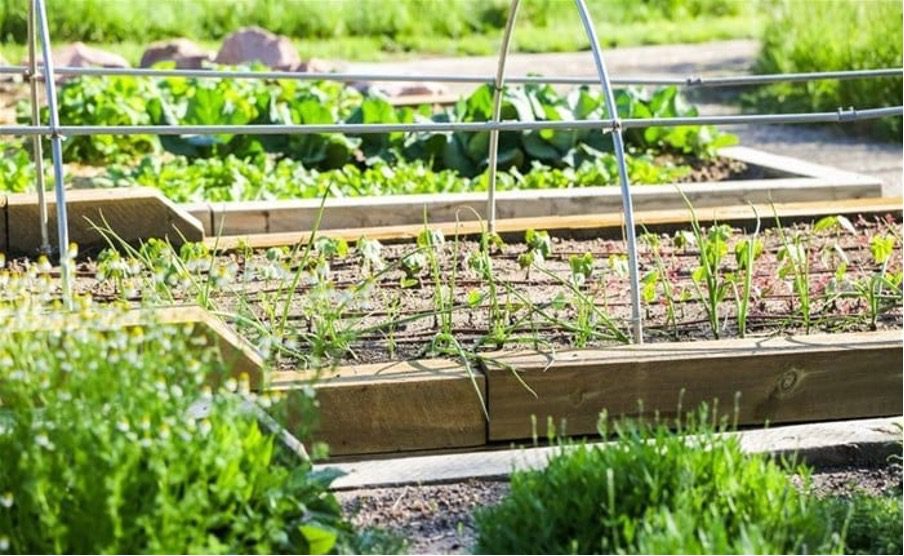
©arinahabich via 123RF
Technically, urban farming refers to the practice of growing food in urban areas to generate profit, but does it make financial and spatial sense?
Considerations in urban areas
The urban farmer has some key issues to consider with regards to land, water, soil, infrastructure, and marketing opportunities. Land is often the limiting factor.
What distinguishes urban farming from traditional farming practices, is that the idea of urban farming is often sold on a lesser need for land. Different types of land can be used, such as residential yards, urban spaces such as rooftops or parking lots, space on institutional land and vacant lots. Small portions of land tend to be more affordable and accessible but tend to limit the scalability of the enterprise.
While this may be feasible for a small family practicing subsistence farming, the production of large, marketable quantities of produce inevitably requires more space. Large open spaces in urban areas are both scarce and expensive, and most farming businesses do not justify the cost of acquiring large portions of land.
Urban farming can be done using a range of different processes, of which SPIN (small plot intensive) and hydroponic systems have become the most popular.
SPIN farming
Small plot intensive farming makes use of underutilised pieces of land in an urban area, to plant and harvest fresh produce with the intention of generating profit. This process makes use of soil as the planting medium and accommodates a range of fruits and vegetables. Soil and water quality are important production factors for the SPIN farmer.
SPIN farmers invest in improving the quality and fertility of the soil present on their land. SPIN farming depends on land and although there are some success stories of SPIN farms feeding families and small communities, these farms are generally not suited to becoming full-time businesses – they are difficult to profitably scale to high output levels.
Hydroponics
In contrast to SPIN farming, hydroponics is a system in which crops are grown in sand, gravel or liquid using water-soluble nutrients and no soil. This is a closed system and excess nutrients can be collected and reused. As hydroponic systems do not make use of soil, good water quality is essential.
Hydroponic systems are typically inside some form of structure and often in vertical layers commonly known as vertical farming. Leafy greens, bell peppers and cucumbers are common hydroponic crops.
Hydroponic systems are known for their efficient water use. In addition, the ability to farm multiple layers on the same surface area, allows hydroponic farmers to harvest higher volumes on the same space compared to a SPIN farmer. Hydroponic farms do, however, have a higher start-up cost than SPIN farms, but are easier to scale and generally more efficient.
Both systems require fixed investments, thus complicating both scaling and relocating the enterprise. Urban farmers face higher susceptibility to theft and vandalism, so careful attention must be given to security measures.
Easy market access
The main advantage of urban farming is potential market access. Urban farms are located in closer proximity to the consumer, significantly decreasing travel costs and often cutting out the middleman. Consumers are becoming increasingly aware of intangible product attributes such as carbon and water footprints, organic and environmentally friendly practices, locally produced and handpicked products.
In some urban areas consumers that value these intangible product attributes, are more concentrated. Urban farmers have the opportunity of entering niche markets with their produce. In higher income urban areas, restaurants and supermarkets tend to promote local and environmentally friendly produce and sell it at a premium.
Some of the marketing models that have been explored by urban farmers include farm-gate purchases, subscription, delivery, wholesale, and retail. They are therefore able to adapt to the specific needs of niche markets. Urban farmers need to secure markets effectively and must be able to maintain production volumes to meet the demand. Farmers are highly dependent on building and maintaining relationships with consumers in their area.
Land size
While urban farming is often praised for using small portions of land, it seems there are different meanings attached to the term. 'Urban farming' can be successful in converting extra yard space into modified vegetable gardens. In the Cape Flats alone, there are more than 6,000 of these 'urban farms'. These families use small portions of land for subsistence farming and are able to trade the surplus at the market or with other community members.
There are many successful subsistence farmers making use of these systems in other urban areas. Some SPIN farms in North America have been reporting sales of $50.000 per annum on a mere 0,4ha (4,000m2).
These systems are all referred to as successful urban farming. However, the technical definition for urban farming is the production of food in urban areas to generate profit; in other words, it is a business. Going by this strict definition, it becomes increasingly more challenging to be a successful urban farmer.
Land remains the limiting factor. SPIN farming enterprises, in particular, struggle to justify the cost of land. This is clearly demonstrated in Table 1. Hydroponics show promising potential in the urban production of fresh produce based on its efficient use of water, space, and energy.
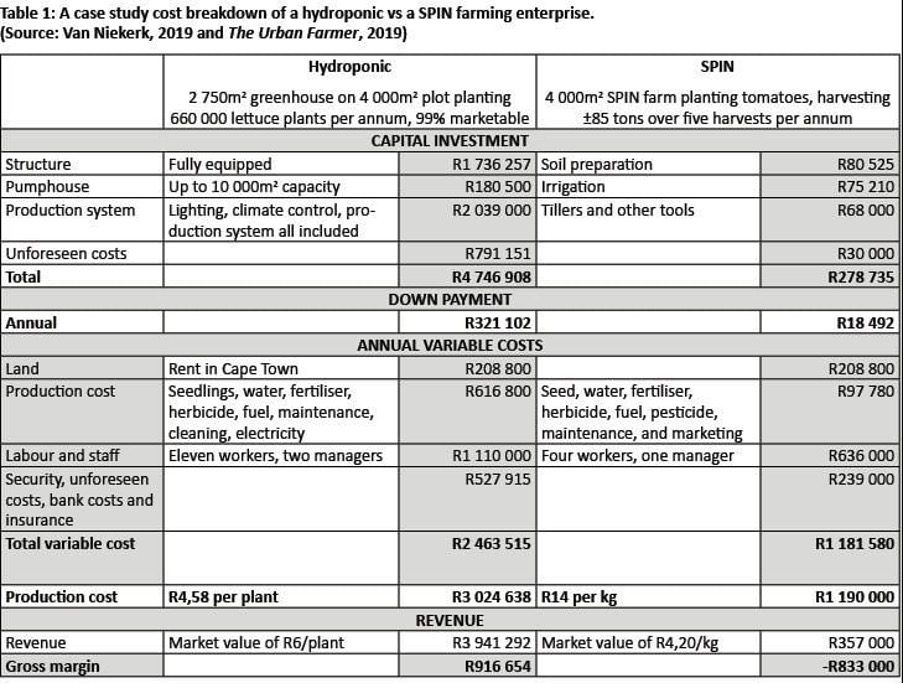
The cost and availability of land vary greatly among South African urban areas. In areas where marketing opportunities are most concentrated, land is scarcer and meeting demand becomes more challenging. Start-up and operational costs will vary significantly based on the location of the farm can be very high, requiring large volumes and/or higher sales prices to be financially sustainable in the long run.
Food for thought
Urban farming has been growing in popularity, whatever the definition. Although ‘urban farming’ as it is loosely referred to has proven to be beneficial and successful in the non-profitable addressing of social issues and even in the backyards of some urban agricultural enthusiasts, experts do not see it becoming a booming business model taking over the traditional fresh produce market in South Africa anytime soon.
Michelle Marais

This article was originally published in the FarmBiz magazine which has since been discontinued. You can read the original publication here: https://www.bizcommunity.com/Article/196/472/206322.html